What Do =>, -> and :: Mean? Programming Operators Explained and Counted

The short answer: => defines an arrow function in JavaScript and TypeScript, and pairs a key or pattern with a value in PHP and Rust. -> reaches into an object through a pointer in C and C++, calls a method on an object in PHP, marks a return type in Rust and Python, and separates a lambda from its body in Java. :: is the scope or path operator in C++, Rust and PHP, and a method reference in Java. Together these three are 62.5% of the 2,278 multi-character operators we counted in 1,190 code snippets.
Key Findings
- •
One in every 40 characters you type in code is part of a multi-character operator (2.47%), about one operator every 84 characters.
- •
::,->and=>make up 62.5% of them.::alone appears 676 times, 433 of them in C++. - •
Every language has a signature operator:
::is 63% of C++'s operators,->51% of PHP's,=>60% of JavaScript's. - •
Strict equality wins. In JavaScript, TypeScript and PHP, 47 of 50 equality checks use
===or!==. - •
88% of operators need Shift, and 41% switch between shifted and unshifted keys halfway through, like
=>and->.
Source: TurboType analysis of 1,190 code snippets in eight languages, 190,433 non-space characters, November 2026.
1. What =>, -> and :: Mean in Each Language
Search for what an arrow means in code and you get an answer for one language. The trouble is that the same two characters do different jobs depending on where you type them. Here is the full map for the three operators people ask about most.
| Operator | Language | Name | What it does | Example |
|---|---|---|---|---|
=> | JavaScript, TypeScript | Arrow, or fat arrow | Defines an arrow function | (a, b) => a + b |
=> | PHP | Double arrow | Pairs a key with a value in arrays and foreach; separates arms in match; body of an fn arrow function | ['id' => 1] |
=> | Rust | Fat arrow | Separates a pattern from its result in match arms and macro rules | Some(x) => x + 1, |
-> | C, C++ | Arrow, member access | Reaches a member through a pointer; p->x is shorthand for (*p).x | user->age = 30; |
-> | PHP | Object operator | Reads a property or calls a method on an object | $user->getName() |
-> | Rust, Python | Return arrow | Declares what a function returns | fn area() -> f64 |
-> | Java | Lambda arrow | Separates lambda parameters from the body; also switch rules since Java 14 | x -> x * 2 |
:: | C++ | Scope resolution | Names something inside a namespace or class | std::string |
:: | Rust | Path separator | Names items inside modules and types, including associated functions | String::new() |
:: | PHP | Scope resolution | Reaches static methods, constants and parent:: (PHP calls it Paamayim Nekudotayim, Hebrew for double colon) | Config::get('db') |
:: | Java | Method reference | Passes a method as a function value | String::length |
In our snippets, -> shows up most in PHP (198 times), where every method call on an object uses it, then Rust (74), C (49) and Java (45). Of Java's 45, 15 are switch rules and 30 are lambdas. Python has 20, all of them return-type hints such as def factorial(n: int) -> int:.
Python has no :: operator. In a slice such as text[::-1] it is two colons with the start and stop left empty.
2. The Most Common Operators in Code
We counted every operator two or more characters long, after removing comments and the contents of strings. Single characters such as =, + and < are not included, because those are counted in our programming symbols analysis.
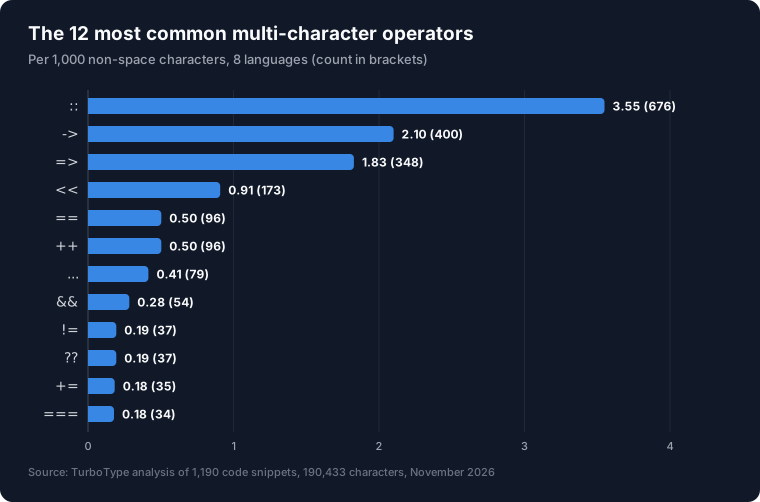
The top three are far ahead of everything else. After them comes <<, and 168 of its 173 appearances are in C++, where it sends output to a stream: std::cout << name;. The other five are in C, where << keeps its original meaning, a bitwise left shift.
Next are == and ++ at 96 each. The increment operator is mostly C (58), and 36 of those sit in the header of a for loop. Python and Rust do not have ++ at all; you write x += 1. The spread operator ... (79) is mostly JavaScript and TypeScript.
3. Every Language Has a Signature Operator
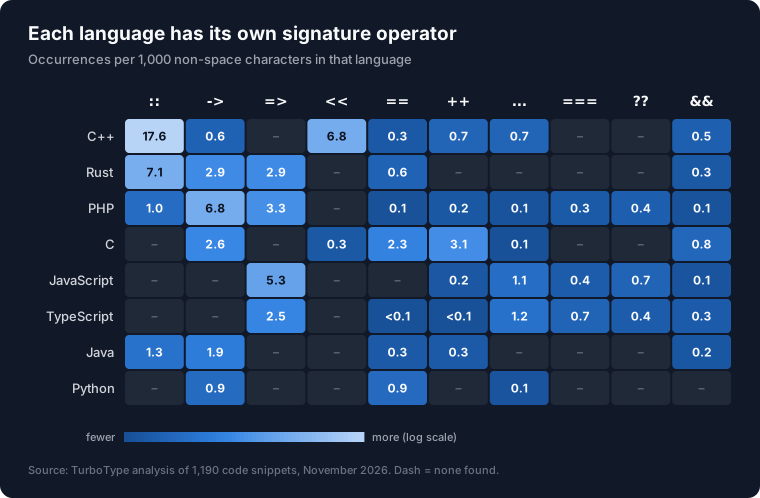
Read across a row and each language has a clear favourite:
- •
C++ is the most operator-dense language in our sample, at 28.2 per 1,000 characters.
::is 63% of that, because the standard library lives instd::. - •
Rust (16.9 per 1,000) uses
::for paths,->for return types and=>for match arms in roughly equal measure after::. It also has 38 range operators (..and..=). - •
PHP (13.2) is built on
->: 51% of its operators.=>adds another 96, from arrays, foreach loops, 6 match expressions and 20 arrow functions written withfn. - •
JavaScript uses
=>for 60% of its operators. Our JavaScript snippets define functions with an arrow 113 times against 21 uses of thefunctionkeyword. - •
Python is the quietest at 3.4 per 1,000, because it spells its logic in words. Where C writes
&&,||and!, Python writesand,orandnot.
4. == vs ===, and the Null-Safe Operators
In JavaScript and PHP, == compares two values after converting them to a common type, and === compares without converting, so the types must match too. Loose comparison produces surprises: in JavaScript '1' == 1 is true, and so is null == undefined. In PHP, "1" == "01" is true because both strings look like numbers.
The snippets we analysed have settled the debate. Across JavaScript, TypeScript and PHP there are 47 strict comparisons (=== or !==) and only 3 loose ones, 94% strict. The one loose comparison in TypeScript is a deliberate idiom: v == null catches both null and undefined in a single check.
| Language | === and !== | == and != | Strict share |
|---|---|---|---|
| JavaScript | 9 | 0 | 100% |
| TypeScript | 21 | 1 | 95% |
| PHP | 17 | 2 | 89% |
A newer family is the null-safe operators, 66 uses in all. ?? (37) returns the right-hand value only when the left is null or undefined, which is different from ||: 0 || 10 gives 10, but 0 ?? 10 gives 0. ?. (17) stops a property chain at the first null instead of throwing, and PHP 8 spells the same idea ?-> (5). ??= (7) assigns only when the variable is null.
5. A Glossary of Multi-Character Operators
For reference, here is every multi-character operator that appears in our sample, with its usual name and how often we saw it.
| Operator | Name | Where | What it does | Count |
|---|---|---|---|---|
<< | Left shift / stream insertion | C, C++ | Shifts bits left; in C++ also writes to a stream | 173 |
== != | Equal / not equal | Most languages | Compares values (loosely in JS and PHP) | 96 / 37 |
++ -- | Increment / decrement | C family, JS, PHP | Adds or subtracts one | 96 / 10 |
... | Spread, rest, variadic | JS, TS, PHP, C, C++ | Expands or collects multiple values | 79 |
&& || | Logical AND / OR | C family, JS, PHP, Rust | Combines conditions; in Rust || can also open a closure with no arguments | 54 / 23 |
?? | Nullish coalescing | JS, TS, PHP | Falls back when the left side is null | 37 |
=== !== | Strict equality | JS, TS, PHP | Compares value and type | 34 / 13 |
.. ..= | Range | Rust | Exclusive and inclusive ranges, as in 0..5 | 30 / 8 |
?. | Optional chaining | JS, TS | Stops at the first null in a chain | 17 |
// | Floor division | Python | Divides and rounds down | 3 |
<=> | Spaceship | PHP (and C++20) | Returns -1, 0 or 1 for sorting | 5 |
6. Why Operators Are Awkward to Type
On a US keyboard, 88% of the operators we counted need Shift for at least one key. That is not the hard part. The hard part is that 41% of them, including =>, ->, !=, >= and ?., mix a shifted key with an unshifted one, so you press or release Shift halfway through a two-character sequence. Miss the timing and you get =. or _> instead of an arrow.
Another 47% are fully shifted (::, &&, ||, ??, ++, <<) and only 12% need no Shift at all (==, ..., --). Because operators make up about one character in 40, and sit between every name you type, they cost more time than their share suggests. Our special characters guide covers the technique: hold Shift with the opposite hand and type each operator as one movement rather than two keys.
Ligature fonts such as Fira Code and JetBrains Mono draw these pairs as single glyphs. That changes how operators look, not the keys you press.
7. Method and Limits
We analysed 1,190 snippets from TurboType's practice tracks: 150 each in JavaScript, TypeScript, Java, C, C++, PHP and Rust, and 140 in Python (ten object-oriented Python snippets were excluded). HTML & CSS was left out because these operators barely apply to it. Comments and the contents of string and character literals were removed first, then operators were matched longest first, so === counts once rather than as ==.
A >> that only closes nested generics, as in List<List<T>>, is not counted as a shift. Limits: practice snippets are short and focused, so full codebases will have different proportions.
8. Frequently Asked Questions
What does => mean in programming?
In JavaScript and TypeScript, => defines an arrow function, as in (a, b) => a + b. In PHP it pairs a key with a value in arrays and foreach loops, separates arms in a match expression, and introduces the body of an fn arrow function. In Rust it separates a pattern from its result in a match arm.
What does -> mean in programming?
It depends on the language. In C and C++, p->x reads member x through the pointer p, the same as (*p).x. In PHP, -> calls a method or reads a property on an object. In Rust and Python it declares a function's return type. In Java it separates lambda parameters from the lambda body.
What does :: mean in C++ and Rust?
In C++, :: is the scope resolution operator: std::string means the string type inside the std namespace. In Rust, :: separates parts of a path, as in std::collections::HashMap or String::new(). PHP uses :: for static members and constants, and Java uses it for method references such as String::length.
What is the difference between == and ===?
In JavaScript and PHP, == compares values after converting them to a common type, so '1' == 1 is true in JavaScript. === compares without converting, so both the value and the type must match. In our sample, 94% of equality checks in JavaScript, TypeScript and PHP used the strict form.
What does ?? mean in JavaScript and PHP?
?? is the null coalescing operator. a ?? b returns a unless a is null (or undefined in JavaScript), in which case it returns b. Unlike ||, it does not treat 0, an empty string or false as missing, so 0 ?? 10 gives 0.
Next Steps:
- Take the 60-second coding typing test in your main language and count how many of your errors land on operators.
- Drill the shifted pairs on the symbols track until
=>and->are one movement. - Practise real code that is heavy on your language's signature operator: C++ for
::, PHP for->, JavaScript for=>.
Related Resources:
All 32 single symbols, named and counted.
How to type the arrow family and other symbols faster.
4,437 semicolons counted across nine languages.
What each language uses, and when it matters.